Competition today is louder, faster, and more visible than ever. Customers don’t just buy products—they broadcast their opinions, frustrations, and comparisons in real time. The result? Every move your rivals make is being discussed somewhere online. The real question is: are you listening?
Introduction
Competitor social listening is the practice of tracking and analyzing conversations about your rivals—their products, campaigns, customer service, sentiment, and market influence. Unlike traditional competitor analysis, which often relies on reports or lagging indicators, social listening gives you a live feed of how the market perceives your competition.
Done well, competitor social listening uncovers more than vanity metrics. It highlights why a competitor’s campaign is resonating, where their products are falling short, and how their customers feel compared to yours. These insights can fuel product innovation, sharpen messaging, and prevent costly blind spots.
In this blog, we’ll break down what competitor social listening is, why it matters, and how to do it step by step. We’ll cover key benefits, a procedural framework, the KPIs that matter, tools worth considering, and real-world examples of brands already using it to stay ahead.
TL;DR
- Competitor social listening means tracking online conversations about rivals—covering products, campaigns, sentiment, influencers, and market share.
- It helps benchmark share of voice, engagement, sentiment, and campaign ROI, giving real-time intelligence beyond traditional competitor analysis.
- A structured framework—goals → competitors → keyword sets → Boolean queries → KPIs—turns chatter into actionable insights.
- Benefits include spotting trends, product bugs, and whitespace opportunities, plus preventing crises and cutting wasted spend.
- Konnect Insights provides enterprise-grade coverage, automation, and CRM/BI integration—making competitor analysis faster, deeper, and scalable.
What is Competitor Social Listening?
At its core, competitor social listening is the process of monitoring and analyzing online conversations about your rivals—across social media, review sites, forums, blogs, and even app stores. It’s not just about counting mentions; it’s about understanding how people talk about your competitors, what pain points they raise, and what makes their campaigns succeed or fail.
Unlike desk research or quarterly reports, competitor social listening delivers intelligence in real time. When a competitor launches a new product, you don’t need to wait for a press release or sales numbers—you can see instant customer reactions, sentiment trends, and adoption barriers as they unfold. This immediacy is what makes social listening a powerful layer of competitor analysis.
The insights go beyond numbers. They can tell you if customers prefer a rival’s pricing model, if a campaign hashtag is generating authentic engagement, or if product complaints (like app crashes or shipping delays) are building into larger risks. These are signals you can act on quickly—by adjusting your own strategy, innovating faster, or targeting gaps your competitor is missing.
Social Listening vs. Competitor Analysis: Key Differences
- Traditional competitor analysis relies on lagging indicators like financial results, campaign case studies, or market share reports. It’s retrospective and often static.
- Competitor social listening captures conversations as they happen. It reveals customer sentiment, campaign traction, and product performance in near real time.
- Where traditional analysis explains “what happened,” social listening helps answer “why it’s happening” and “what we should do next.”
| Aspect | Traditional Competitor Analysis | Competitor Social Listening |
| Data Source | Reports, surveys, financial results, market research | Real-time social media, reviews, forums, blogs, app stores |
| Timeframe | Retrospective (quarterly/annual snapshots) | Immediate, continuous monitoring |
| Focus | What happened (sales, campaigns, share of voice after the fact) | Why it’s happening (sentiment, feedback, emerging trends) |
| Depth of Insight | High-level metrics, static comparisons | Context-rich signals: pain points, product bugs, campaign traction |
| Actionability | Slower to influence strategy | Enables quick adjustments, proactive campaigns, crisis prevention |
| Output | Reports, presentations, periodic reviews | Dashboards, alerts, ongoing insights feeding daily decisions |
In short, competitor social listening transforms competitive intelligence from a backward-looking report into a forward-looking strategy tool.
Benefits of Competitor Social Listening
Competitor social listening isn’t just about keeping tabs on rivals—it’s about transforming their customer conversations into intelligence you can act on. Here are eight key benefits, with examples of how brands apply them.
Benchmark Your Social Performance
Social listening allows you to measure your brand against competitors on metrics like share of voice, engagement rate, sentiment, and click-throughs. For example, if your campaign generates fewer mentions than a rival’s, you can adjust your creative strategy or channel mix to close the gap.
Discover Valuable Insights
Competitor campaigns leave trails of data. By analyzing what’s being said about them, you uncover why certain campaigns succeed—or fail. A food delivery app, for instance, may find that a rival’s “30-minute delivery” campaign attracts attention but is dragged down by complaints about inconsistency. That gap becomes your opportunity.
Spot Industry Trends Early
Listening across your industry helps identify emerging topics before they become mainstream. A retail brand could notice early chatter about “virtual try-ons” through competitor mentions and adopt it before the trend peaks, gaining first-mover advantage.
Discover New Opportunities and Influencers
Competitor conversations often reveal influencers or creators they collaborate with. By monitoring these, you can identify rising voices in your niche and partner with them early. This also exposes audiences your competitors may be overlooking.
Track Competitor Influence and Market Share
By combining volume (mentions) with sentiment (positive vs. negative), you can assess how influential competitors are in shaping industry conversations. A competitor with high mentions but low sentiment may look dominant on paper but is vulnerable in reality.
Analyze Sentiment for Brand vs. Rivals
Understanding not just how often, but how positively or negatively competitors are discussed helps position your brand. If customers complain about a competitor’s pricing model, you can amplify your own messaging on value or transparency.
Find Competitor Product Bugs
Social listening extends beyond social media into app stores, forums, and review platforms. If customers are reporting bugs like “crashes after update” for a competitor’s app, you gain insights into their product challenges. This intelligence can inform your own roadmap—or your marketing.
Discover Competitor Whitespace
One of the biggest advantages of competitor listening is spotting unmet customer needs. If users consistently ask for a feature your competitor doesn’t provide—say, “dark mode” in a productivity app—you can seize that whitespace and deliver it first.
Competitor social listening turns raw conversations into a competitive advantage. From benchmarking performance to identifying bugs and whitespace, it gives you both defensive intelligence (where competitors are weak) and offensive opportunities (where you can lead).
How to undertake Competitor Analysis with Social Listening (Step-by-Step Framework)
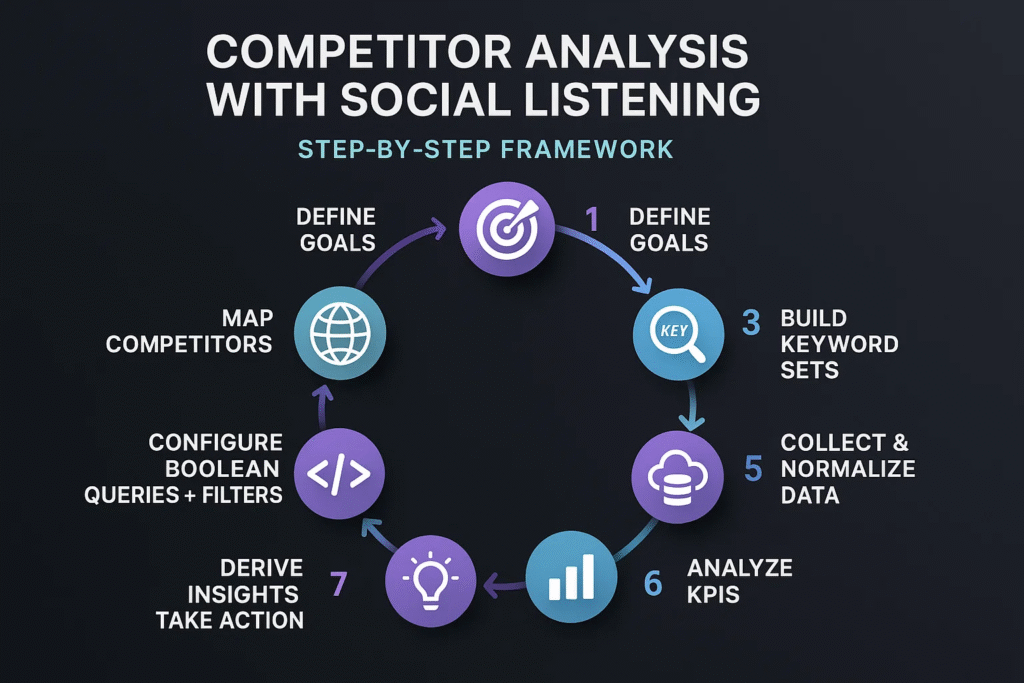
Competitor social listening works best when it’s systematic. Rather than just pulling mentions about rivals, you need a structured workflow that transforms raw chatter into actionable intelligence. Here’s a step-by-step process to follow.
1. Define Goals
Start with clarity. Do you want to benchmark brand performance, spot competitor weaknesses, analyze campaign impact, or identify whitespace opportunities? Each goal influences the type of data you collect and how you interpret it. For example, benchmarking requires volume and engagement metrics, while whitespace discovery leans on customer pain points and unmet needs.
2. Map Competitors
Go beyond the obvious big players. Social listening often reveals secondary competitors—regional brands, startups, or disruptors—who may not appear in traditional reports but are taking market share. Mapping should include:
- Direct competitors (same products).
- Indirect competitors (alternative solutions).
- Emerging players (startups with traction).
3. Build Keyword Sets
Keywords are the backbone of competitor listening. Build sets across:
- Branded: competitor names, misspellings, and hashtags.
- Product/Feature: SKUs, product lines, attributes.
- Campaign: slogans, hashtags, seasonal terms.
- People: executives, brand ambassadors, influencers.
- Industry: sector-wide terms (e.g., “BNPL” in banking).
Grouping these ensures full coverage of competitor mentions.
4. Configure Boolean Queries + Filters
Use operators like AND, OR, NOT, wildcards, and localisation variants to capture mentions accurately. Add negative keywords to cut noise. For example:
(“CompetitorX” OR “Competitor X”) AND (“delivery” OR “shipping”) NOT “resale”
Filters (geo, language, source) help narrow results to the markets that matter most.
5. Collect & Normalize Data
Social listening tools like Konnect Insights aggregate mentions from multiple channels—social media, forums, app stores, review sites, news. Normalize the data so that metrics (e.g., likes, retweets, reviews) are comparable across platforms.
6. Analyze KPIs
Once data is clean, focus on competitive KPIs:
- Share of Voice (SOV): competitor mentions ÷ total market mentions.
- Sentiment Benchmark: competitor positive vs. negative ratio.
- Engagement Benchmark: competitor engagement ÷ your engagement.
- Campaign Lift: % increase in mentions/engagement during campaign.
These metrics show not just what competitors are doing, but how the market is reacting.
7. Derive Insights + Take Action
Translate metrics into strategy:
- If a competitor campaign gets traction but attracts negative sentiment, amplify your messaging around that weakness.
- If competitor influencers are trending, evaluate if they fit your brand or find alternative voices.
- If reviews highlight bugs, emphasize reliability in your marketing.
8. Measure Impact
Competitor listening isn’t a one-off exercise. Refresh reports quarterly and align them with your campaign cycles. Use the same KPIs to measure improvements over time and to track how your brand’s moves affect competitor performance.
By following this framework, competitor social listening evolves from raw data collection into a structured system for continuous intelligence. It gives your teams an always-on radar: capturing what competitors are doing, how customers are responding, and where your brand can take the lead.
KPI Framework & Benchmarks
Competitor social listening becomes powerful when you move from raw mentions to measurable KPIs. These metrics allow you to compare your brand’s performance against rivals and track improvements over time.
Share of Voice (SOV)
Formula:
SOV= Brand MentionsTotal Market Mentions 100
If your brand has 2,000 mentions out of 10,000 in the market, your SOV is 20%.
- Good: 10–20%
- Better: 20–30%
- Best: 30%+ (indicates clear leadership)
[Insert dashboard placeholder: SOV pie chart comparing competitors]
Engagement Rate vs. Competitors
Formula:
Engagement Rate = Likes + Comments + Shares / Followers or Reach * 100
This shows not just who’s louder, but who drives action.
- Good: 1–2%
- Better: 3–5%
- Best: 6%+ (top-tier engagement relative to audience size)
[Insert dashboard placeholder: engagement bar graph across competitors]
Sentiment Ratio
Formula:
Sentiment Ratio= Negative Mentions / Positive Mentions
If Competitor A has 3,000 positive vs. 1,000 negative mentions, the ratio is 3:1.
- Good: 1.5:1
- Better: 2:1
- Best: 3:1+ (signals strong brand equity)
[Insert dashboard placeholder: sentiment trend line]
When tracked consistently, these KPIs create a benchmarking system: you’ll know not just where you stand today, but whether you’re gaining or losing ground compared to competitors. Konnect Insights dashboards make this data digestible with real-time visualizations and automated reporting.
Tools & Comparisons
Not all competitor social listening tools are built the same. Some are free or entry-level, useful for surface monitoring, while others are enterprise-grade platforms designed for scale, integration, and advanced analytics. Choosing the right tool depends on your business goals, markets, and data needs.
Free Competitor Social Listening Tools
If you’re just starting, free tools like Google Alerts, TweetDeck, or basic versions of common social listening tools can help track mentions of competitor names or campaign hashtags. They’re useful for spotting spikes in activity but limited in scope—they won’t provide sentiment analysis, influencer mapping, or multi-language coverage.
Enterprise-Grade Tools
For brands that operate across multiple markets or industries, enterprise tools provide much deeper insights. They aggregate data across channels (social, forums, reviews, app stores, news), apply AI-driven sentiment analysis, and integrate with CRM and BI systems for decision-making at scale.
Social Listening Tools Comparison
| Feature | Free Tools (e.g., Google Alerts, TweetDeck) | Enterprise Tools (e.g., Konnect Insights) |
| Channel Coverage | Limited (news, Twitter) | Broad (social, reviews, forums, app stores, news) |
| Real-Time Alerts | Basic email alerts | Advanced alerts with thresholds & workflows |
| Influencer Mapping | Not available | Available with scoring & segmentation |
| Integrations | None or very limited | CRM, BI, APIs, automation-ready |
| Multi-Language Support | Rare | Robust, including regional/local variants |
Why Konnect Insights
Konnect Insights is a full-stack, enterprise-grade solution. It goes beyond tracking mentions—it consolidates competitor insights across multiple data sources, applies advanced Boolean filters, supports multi-language monitoring, and integrates seamlessly with CRM, BI, and automation tools. Whether you need real-time alerts, influencer mapping, or API access, Konnect Insights is designed to scale with your competitive intelligence needs.
ROI of Competitor Social Listening
The value of competitor social listening lies in how quickly insights translate into business outcomes. Instead of tracking rivals for curiosity’s sake, the goal is to act in ways that deliver measurable ROI.
Campaign Lift
By understanding which competitor campaigns resonate and why, you can refine your own messaging. If a rival’s product launch drives high engagement, social listening can reveal the hashtags, influencers, and content formats behind it—letting you adapt and capture part of the attention.
Cost Savings
Social listening can highlight when a competitor’s campaign is failing. If sentiment is negative or engagement drops quickly, you know to avoid similar tactics. This helps reduce wasted spend on strategies unlikely to deliver results.
Crisis Prevention
Monitoring competitor sentiment also protects your brand. Negative spikes about pricing, service delays, or product issues at a rival are warning signals—you can proactively prepare your teams in case similar issues arise in your ecosystem.
Mini Case Scenario
Imagine two smartphone brands launch new devices. Competitor A faces online backlash about overheating issues, spotted early through app store reviews and forums. Competitor B, tracking these conversations, accelerates its marketing push around “battery safety” and “long-lasting performance.” The result? Higher trust, improved campaign engagement, and incremental sales—all from responding faster to competitor weaknesses.
With competitor social listening, ROI is clear: smarter campaigns, leaner budgets, and fewer blind spots.
Actioning & Integration
Competitor social listening is only valuable when insights move beyond dashboards and into business decision-making. The key is integrating findings directly into your existing CRM, BI, and workflow systems so they inform strategy at the right time.
For example, if competitor complaints about pricing begin to spike, these insights shouldn’t remain in a listening tool—they should feed into your pricing strategy deck or sales enablement playbooks. Similarly, if customers highlight bugs in a rival’s app, those signals can be passed to your product team to prioritize stability messaging or fast-track a reliability feature.
Cadence & SLAs
Competitor reports work best on a set schedule. Many teams run:
- Monthly reports → tracking share of voice, sentiment, and engagement benchmarks.
- Quarterly deep-dives → linking competitor trends to business outcomes, presented in leadership reviews.
Service-level agreements (SLAs) should define how quickly spikes in competitor sentiment or campaign activity are reported—e.g., alerts sent within 24 hours.
Automation in Konnect Insights
Konnect Insights allows teams to set alerts and workflow triggers:
- A negative sentiment surge about a competitor triggers a Slack/Teams notification.
- High-performing competitor campaign keywords automatically flag in a dashboard.
- Data syncs directly into BI tools, ensuring leadership sees competitor intelligence in the same reports as customer data.
When competitor insights flow seamlessly into daily decision-making, they shift from passive monitoring to proactive strategy.
Competitor analysis in action
A leading private-sector bank in India noticed recurring customer frustration aimed at competitors over hidden charges and mobile app downtime. Through social listening, the bank’s analytics team tracked spikes in complaints across Twitter and app store reviews whenever rival digital services went offline.
Rather than relying on delayed survey data, the bank acted on these real-time insights. They launched campaigns emphasizing “no hidden fees” and “always-on digital banking”, while product managers used the findings to double down on mobile app reliability as a differentiator.
The payoff was twofold: social sentiment improved significantly, and adoption of the bank’s digital services accelerated. Competitor weaknesses became the bank’s strengths—proving how competitor social listening, when connected to marketing and product strategy, drives both brand trust and measurable business outcomes.
FAQs
1. What is competitor analysis with social listening?
It’s the process of monitoring online conversations about your competitors—across social media, forums, reviews, and news—to understand their strengths, weaknesses, and market perception.
2. Which tools are best for competitor social listening?
Free tools like Google Alerts or TweetDeck can cover basic monitoring, but enterprise platforms such as Konnect Insights, Talkwalker, or Sprinklr provide multi-channel coverage, sentiment analysis, influencer mapping, and BI/CRM integrations.
3. What metrics matter most?
The key competitive KPIs include Share of Voice (SOV), sentiment benchmarks, engagement rates, and campaign lift. Together, they show not just how much attention competitors get, but whether it’s positive or negative—and how it compares to your brand.
4. How do I build competitor keyword sets?
Start with competitor brand names and misspellings, then add product features, campaign hashtags, executive names, and industry terms. Grouping these into categories ensures full coverage and avoids blind spots.
5. How do I find competitor influencers?
Social listening platforms highlight which accounts or creators drive the most engagement for your competitors. Look at who frequently shares or is mentioned alongside competitor campaigns—these are often potential influencers to track or even partner with.
6. How often should I run competitor reports?
Most teams review monthly reports to track benchmarks and quarterly deep-dives for strategic planning. Real-time alerts should be set for sudden spikes in competitor activity or sentiment shifts.
7. Can social listening predict competitor launches?
Yes—early signals like new hashtags, influencer partnerships, or product-related chatter often surface before official announcements. Monitoring these patterns can give you a valuable head start.
8. What are common mistakes in competitor listening?
The biggest pitfalls are using too few keywords, ignoring misspellings, and failing to filter noise with Boolean logic. Another mistake is collecting data without connecting it to decision-making.
9. Is competitor social listening legal and ethical?
Yes—when done properly. Social listening only tracks publicly available data. The key is to avoid sensitive personal data and respect privacy regulations like GDPR and CCPA.
Conclusion
Competitor social listening gives you an edge in markets where speed and insight make the difference. By analyzing how rivals are perceived—what campaigns resonate, where customers express frustration, and which trends they’re slow to catch—you can run smarter campaigns, react faster to shifts, and build stronger positioning.
Konnect Insights enables this at scale. With structured keyword frameworks, advanced Boolean queries, sentiment benchmarks, influencer mapping, and seamless CRM/BI integrations, it transforms competitor data into actionable intelligence. Instead of waiting for quarterly reports, you’ll have a real-time radar on the competition.Book a demo to see how Konnect Insights helps you benchmark competitors and stay ahead of the market.