Social media management has evolved far beyond scheduling posts and replying to comments. In 2026, brands need tools that help them understand customer sentiment, manage conversations across multiple channels, automate workflows, and deliver connected customer experiences, not just social content.
With customer expectations rising across industries, businesses are increasingly prioritizing AI-driven analytics, omnichannel engagement, and unified dashboards that give teams a complete view of the customer journey. In fact, over 80% of companies now treat customer experience (CX) as a core part of their social media strategy, not a separate function.
Sprout Social remains a popular choice for social publishing and engagement, but many growing brands are beginning to realize they need more scalability, deeper insights, integrated CRM capabilities, and smarter automation than a social-only platform can offer.
Whether you’re an agency managing multiple clients, a high-growth startup, or an enterprise looking for unified CX visibility, the landscape of social media and CX platforms has expanded, and there are powerful alternatives worth considering.
Here are the best Sprout Social alternatives redefining how brands engage, analyze, and elevate customer experience in 2026.
What to Look for in a Sprout Social Alternative
Before choosing a Sprout Social alternative, it helps to know what modern social and CX teams actually need in 2026. Social-only workflows are no longer enough, brands expect platforms that combine analytics, automation, omnichannel engagement, and deep customer intelligence.
Here’s a clear checklist of the key features to evaluate when comparing tools:
AI-Powered Social Listening & Sentiment Analysis
Look for platforms that go beyond basic mentions and offer AI-driven sentiment insights, emotion detection, anomaly alerts, and trend discovery. This helps teams understand why conversations are shifting, not just what people are saying.
Omnichannel Engagement (Social, Email, Chat, Reviews, WhatsApp)
A modern CX platform should unify conversations across all digital touchpoints, not just social media. The ability to manage social, email, chat, WhatsApp, reviews, and web mentions in one inbox is essential for a consistent customer experience.
Automation & SLA Tracking for CX
Smart automation like auto-tagging, routing, SLA monitoring, bulk actions, and workflow triggers can dramatically reduce operational load. Brands should prioritize platforms with CX-ready automation rather than simple social scheduling rules.
Advanced Analytics & BI Dashboards
Teams need more than engagement stats. Look for platforms with BI dashboards, customizable charts, omnichannel analytics, and role-based reporting for marketing, CX, operations, and leadership.
Customizable Reporting & Unified Customer Profiles
Top platforms offer flexible reporting and a 360° customer profile, showing every interaction across social, email, chat, reviews, and more. This unified view makes personalization and faster resolutions much easier.
Ease of Integration with CRMs & Martech Stack
Check for native integrations with tools like Salesforce, HubSpot, Genesys, Marketo, and other marketing automation or CCaaS platforms. A platform that slots cleanly into your existing stack will always scale better.
Scalable Pricing for Teams & Enterprises
Transparent, flexible pricing that works for small teams and large enterprises is key. Avoid rigid per-user costs or feature-limited plans that restrict growth.
10 Best Sprout Social Alternatives in 2026
As brands move beyond basic scheduling and community management, many teams find themselves searching for tools that offer deeper analytics, stronger automation, and a more unified way to manage customer experience. The market has expanded quickly, and there are now several platforms that give businesses more flexibility, omnichannel coverage, and AI-powered insights than traditional social-only tools.
Whether you’re looking for smarter reporting, a unified inbox across all channels, CRM-level visibility, or enterprise-grade integrations, here are the 10 best Sprout Social alternatives in 2026, each with its own unique strengths depending on your team’s goals and CX maturity.
1. Konnect Insights: The #1 All-in-One Sprout Social Alternative
If you’re looking for a Sprout Social alternative that goes beyond scheduling, inbox management, and surface-level analytics, Konnect Insights stands out as the most complete option in 2026. It’s built as a unified Customer Experience Management (CXM) platform bringing social listening, omnichannel engagement, Social CRM, analytics, publishing, reviews, surveys, and AI together in one powerful workspace.
For brands that want deeper insights, automation, and a 360° view of customer interactions, Konnect Insights offers capabilities far beyond traditional social media tools. This makes it one of the strongest choices for enterprises, agencies, and any business scaling their CX and social operations.
Key Features of Konnect Insights
Unified CXM Platform
Everything lives under one roof, social listening, publishing, ticketing, analytics, agent productivity tools, reviews, surveys, and AI-powered insights.
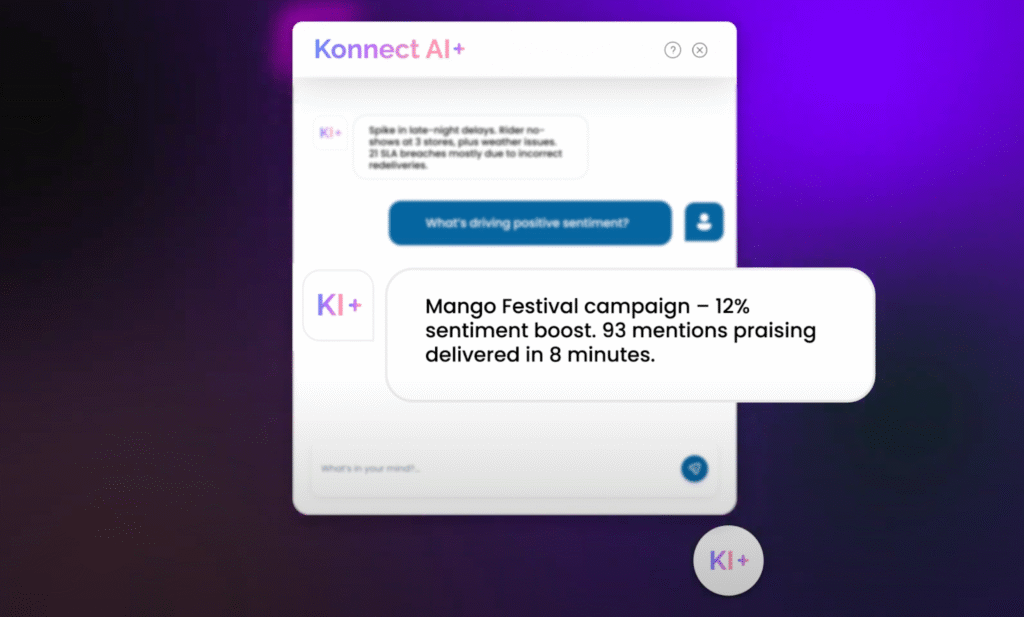
Konnect AI+
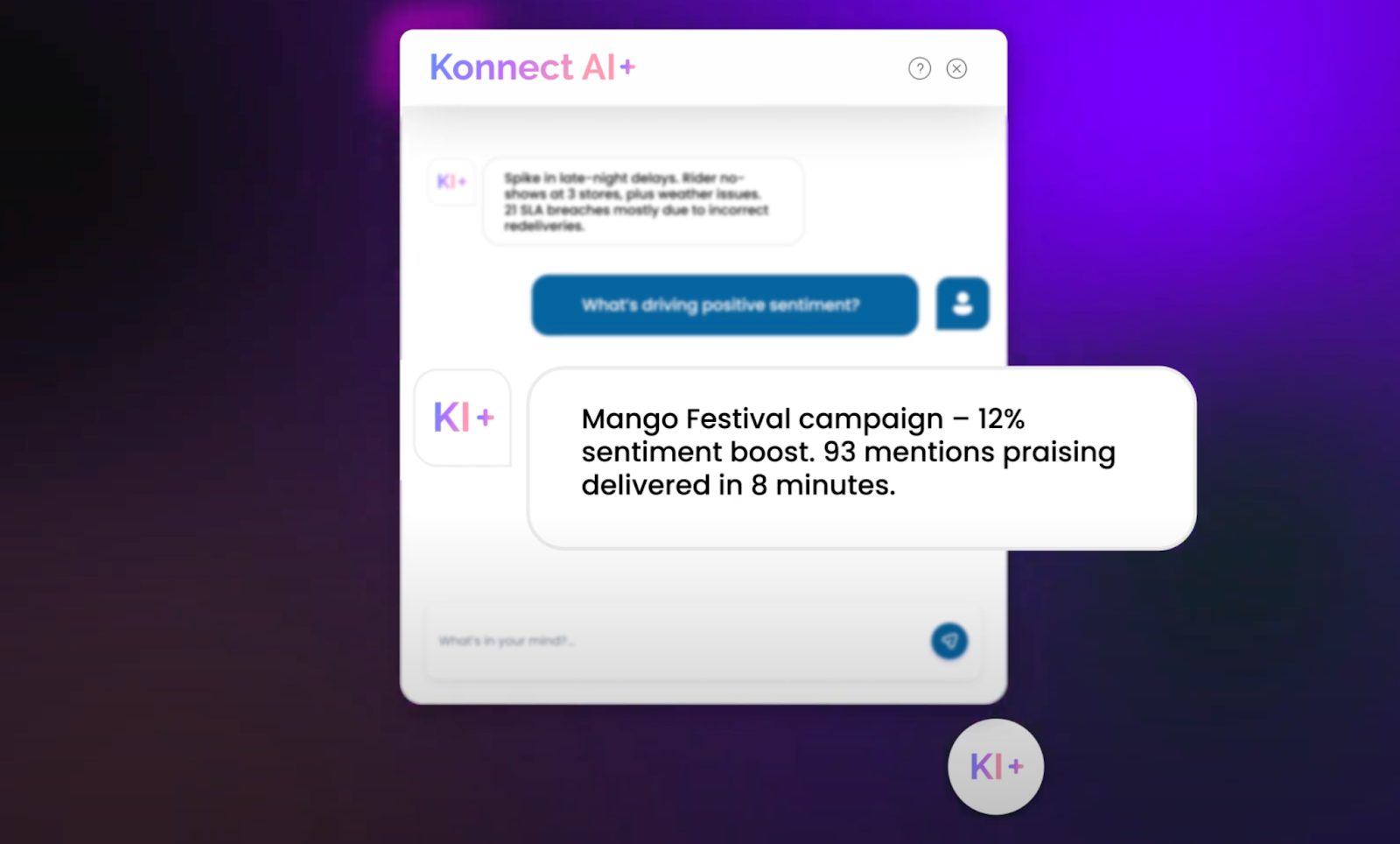
Konnect AI+ goes far beyond basic automation. It analyzes conversations across every channel in real time, detecting sentiment shifts, emotion, churn signals, and emerging issues with high accuracy. Agents get instant summaries, smart response suggestions, and contextual cues that help them act faster. Leaders get predictive insights, anomaly alerts, and intelligent tagging that streamline operations and reveal trends early. In short, Konnect AI+ turns raw conversations into actionable intelligence at every step of the workflow.
360° Customer View
All customer interactions across social, email, chat, WhatsApp, reviews, and calls are organized into a unified profile, giving teams full context before responding.
Omnichannel Inbox
A consolidated workspace for handling conversations across social channels, email, WhatsApp, web chat, reviews, app store feedback, and CTI-integrated calls ensures users don’t waste time switching tabs and have a consistent context across channels.
Built-In Automation & SLA Management
Functionalities like automated ticket routing, tagging, assignment rules, SLA tracking, and workflow triggers help cut down on manual work and speed up how quickly you can respond.
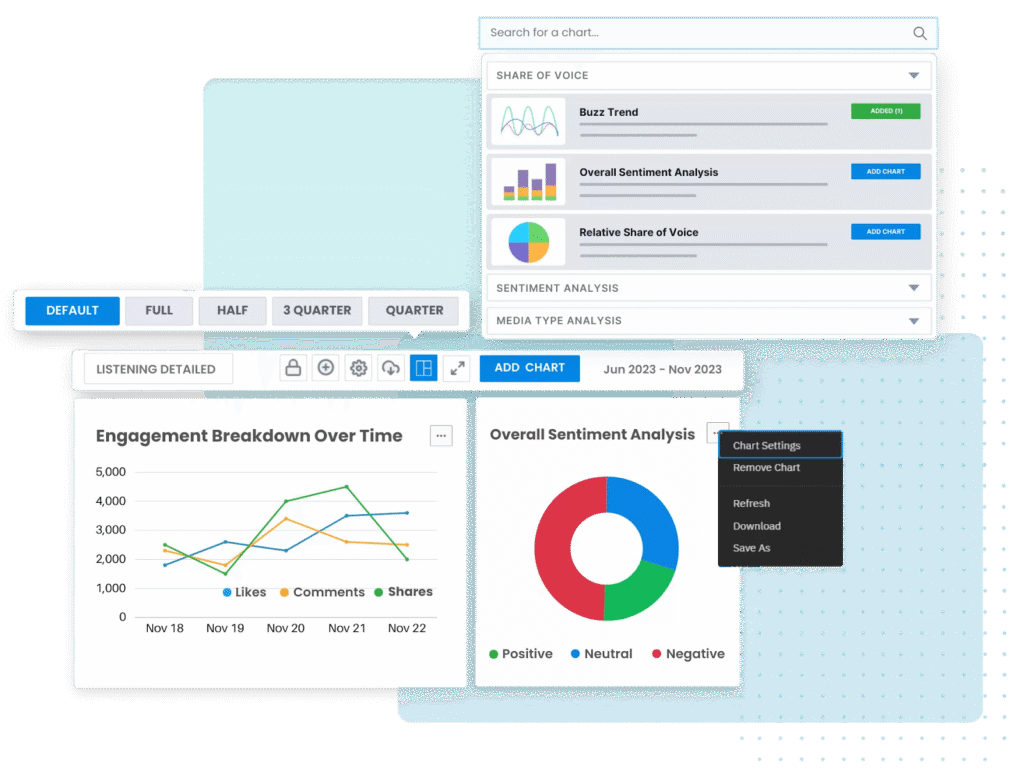
Advanced BI Dashboards & Reporting
Build dashboards the way your teams actually work. Marketing, CX, operations, and leadership get their own customized views, tracking KPIs, campaign performance, sentiment shifts, agent efficiency, and anything else that matters most.
Centralized Configuration Hub
CX teams run smoother when everything is easy to manage. Konnect Insights lets you set SLAs, TATs, automation rules, permissions, and tagging structures from one clean interface giving you the control you need to keep workflows consistent and customer experience on track.
1000+ Integrations
Connect with Salesforce, HubSpot, Genesys, AppFoundry, Freshdesk, Marketo, and thousandsof tools across CRM, CCaaS, marketing automation, and collaboration.
Pros
- Complete CX + social + analytics platform
- AI built natively across workflows
- Advanced reporting with BI dashboards
- Unified customer view across all channels
- Strong enterprise integrations
- Flexible pricing for teams of all sizes
- Dedicated onboarding and support
Cons
- Works best when multiple modules are adopted
- Feature depth may feel extensive for very small teams
Pricing
Konnect Insights offers modular, scalable pricing based on users, channels, and add-ons. Plans are transparent and designed for both mid-size teams and large enterprises.
Explore pricing or request a custom plan based on your CX needs.
Reviews
Konnect Insights is consistently rated highly for:
- Ease of implementation
- Breadth of analytics
- Quality of customer support
- Reliability at scale
- Unified workspace for CX and marketing teams
Users often mention that the platform helps them centralize workflows, reduce dependency on multiple tools, and get faster insights.
Who It’s For
Konnect Insights is built for small teams and large enterprises alike. It grows with your brand, whether you’re just getting started with structured social workflows or managing a complex CX ecosystem across regions and systems. With seamless integrations, flexible configurations, and a unified workspace, it fits effortlessly into setups ranging from simple marketing teams to multi-department CX operations in BFSI, telecom, retail, automotive, travel, QSR, and more.
Book a personalized demo with Konnect Insights and see why it leads 2026’s CXM evolution.
2. Zoho Social
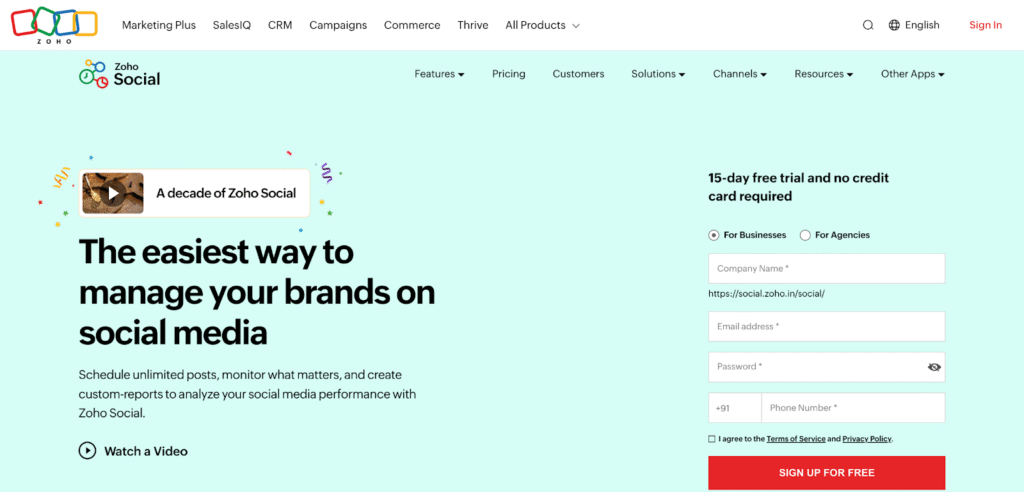
Zoho Social is a solid choice for small and mid-sized businesses that want a clean, easy-to-use platform for scheduling, publishing, and monitoring social activity. Its intuitive interface and “set-it-and-forget-it” scheduling make it especially appealing to marketing teams managing multiple profiles without needing enterprise-level CX capabilities
Key Features of Zoho Social
Intuitive UI & Simple Scheduling
Zoho Social focuses on simplicity. Teams can schedule posts, manage a content calendar, and track engagement without any learning curve.
SmartQ Technology
One of Zoho Social’s standout features, SmartQ suggests the best times to publish based on when your audience is most active, helping posts reach more people organically.
Team Collaboration Tools
Shared calendars, approval workflows, drafts, and internal comments make it easy for teams to coordinate campaigns and stay aligned.
Social Monitoring & Analytics
Zoho Social offers keyword tracking, basic listening, and platform-level analytics, helpful for brands that want to track performance without diving into deep BI-level reporting.
Pros
- Very easy for teams to onboard and start using
- SmartQ optimizes post timings automatically
- Built-in collaboration features for content planning
- Affordable for small teams and growing businesses
Cons
- Primarily a social media management tool, not a full CX suite
- Limited in advanced listening or omnichannel engagement
- Analytics are more surface-level compared to enterprise platforms
Pricing
Zoho Social offers competitive, tier-based pricing suitable for small teams and mid-sized companies. Plans scale based on number of brands, users, and publishing needs.
Reviews
Zoho Social earns strong reviews for:
- Ease of use
- Clean design
- Smart scheduling
- Value for money
Users, in particular, appreciate how quickly new team members can adapt to the platform.
3. Oktopost
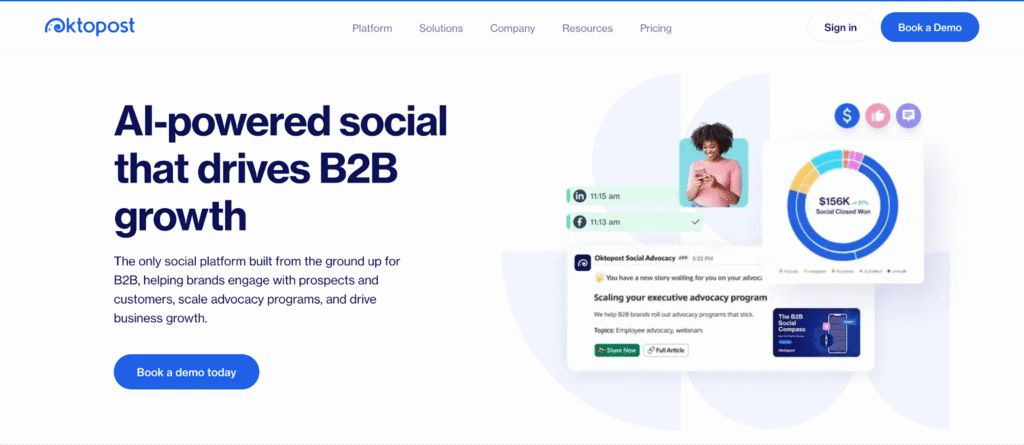
Oktopost is purpose-built for B2B companies that want to tie social media activity directly to leads, pipeline, and revenue. Instead of focusing on traditional engagement metrics, Oktopost leans heavily into attribution, showing marketing teams how social interactions contribute to actual business outcomes. For brands with long sales cycles, SDR workflows, or account-based strategies, Oktopost offers the visibility that general social tools can’t provide.
Key Features of Oktopost
Lead Generation & Attribution
Oktopost stands out for its ability to connect social engagement to CRM outcomes. Every click, share, and visit can be tracked through to lead creation or opportunity progression.
Deep CRM & MAP Integrations
It integrates tightly with Salesforce, HubSpot, and Marketo, making it perfect for demand-gen teams that rely on accurate, real-time CRM sync.
B2B-Focused Publishing & Campaign Tools
Scheduling, content routing, UTM tagging, and employee advocacy features help teams amplify reach and track campaign performance with precision.
Conversion Metrics from Social Campaigns
Unlike most social tools, Oktopost directly links social touchpoints to pipeline metrics making ROI reporting much easier for B2B marketers.
Pros
- Purpose-built for B2B demand generation
- Strong integrations with Salesforce, Marketo, and HubSpot
- Clear attribution paths from social to leads and revenue
- Employee advocacy features to boost reach
- Ideal for LinkedIn-heavy teams
Cons
- Focused primarily on B2B; not ideal for B2C brands
- Limited omnichannel engagement beyond social
- More analytics- and attribution-first than CX-focused
Pricing
Oktopost offers custom pricing based on company size, integrations, and usage needs. Pricing is generally geared toward mid-sized and enterprise B2B teams.
Reviews
Users consistently highlight Oktopost for:
- Reliable CRM integrations
- Accurate attribution reporting
- Strong ROI visibility
- Smooth workflows for B2B content teams
It’s especially well-rated among marketing teams that need a direct line between social activity and revenue outcomes.
4. Buffer
Buffer has earned its reputation as one of the easiest social media tools to pick up and use, which is why it’s so popular with startups and lean marketing teams. If your primary goal is to plan content, keep a clean posting schedule, and understand which posts are performing well, Buffer does exactly that without any noise or complexity.
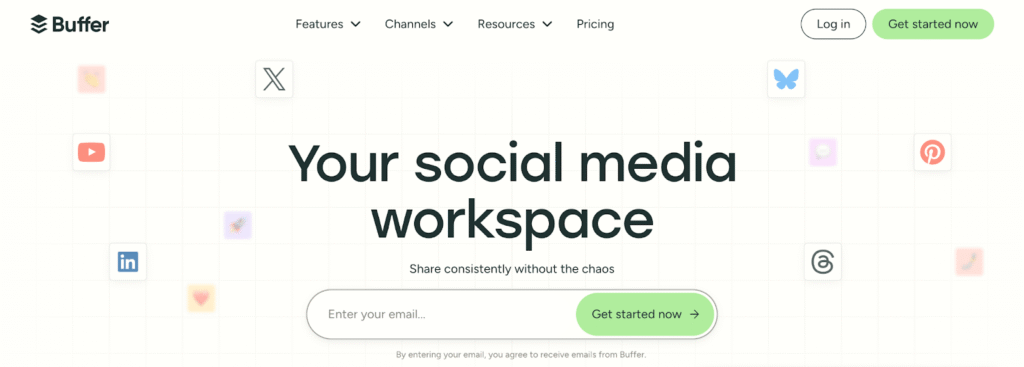
Its interface is clean and distraction-free. You can map out your content calendar, drop posts into time slots, and preview everything in a single glance. Teams that don’t want heavy dashboards or complicated workflows usually find Buffer refreshing, it does the job, and it does it without trying to be more than what it is.
One of Buffer’s strengths is its analytics. While not as deep as full CX or BI tools, it gives you enough to understand what’s working: top posts, engagement trends, best posting times, and platform-specific performance. For many startups, that level of clarity is all they need to improve their content strategy.
Buffer also includes a unified inbox for managing comments and DMs across platforms. It’s simple, but it keeps conversations organized, making it easier for small teams to reply quickly without hopping between apps.
Pros
- Incredibly simple to set up and use
- Clean, intuitive content calendar
- Solid analytics for post performance
- Ideal for small teams managing multiple profiles
Cons
- Not designed for advanced listening or CX
- Limited automation and workflow depth
- No omnichannel capabilities
Pricing
Buffer’s pricing is startup-friendly, with affordable plans that scale based on the number of channels and features you need. Great for teams that want social scheduling without enterprise-level costs.
Reviews
Users love Buffer for its simplicity, reliability, and ease of onboarding. It’s especially appreciated by solo marketers, early-stage brands, and small teams that want an uncomplicated tool to keep their social presence consistent.
5. Agorapulse
Agorapulse is a great fit for teams that want a straightforward, reliable way to manage conversations across social platforms. It’s built around the idea of keeping all your messages, comments, and reviews organized, which is why it’s especially popular among agencies and small to mid-sized marketing teams handling multiple profiles. If your focus is smooth communication, clear inbox management, and simple collaboration, Agorapulse delivers exactly what you need.
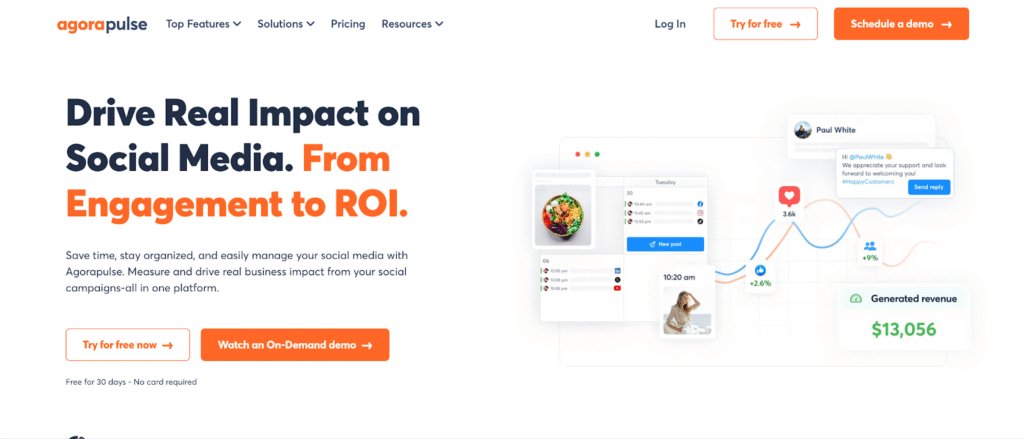
Its strength lies in how effortless it makes reputation monitoring. Instead of juggling notifications across different platforms, teams get one unified inbox where every comment, message, and review is easy to track and respond to. Add to that its clean publishing tools and solid reports, and you get a platform that helps teams stay productive without complicating their workflow.
Key Features
Agorapulse offers a unified social inbox, publishing and scheduling tools, review tracking, competitor analysis, and built-in collaboration workflows. The platform also includes basic social listening and reporting features, enough for most SMB and agency use cases.
Pros
Marketers appreciate how Agorapulse simplifies inbox management. The tool keeps everything organized, supports team collaboration, and offers clear reports clients can understand. It’s ideal for teams that want efficiency without the heavy features of enterprise platforms.
Cons
Agorapulse focuses mainly on social media workflows. It doesn’t offer omnichannel CX capabilities, advanced listening, or deeper automation, which growing brands might eventually need.
Pricing
The platform offers tiered pricing based on features and the number of profiles you manage, making it accessible for smaller teams while still scaling well for agencies.
Reviews
On Gartner and Capterra, Agorapulse receives strong feedback for ease of use, fast onboarding, and clean workflows. Users often highlight its inbox as one of the best in the market for social media management, especially for businesses juggling multiple clients or brand pages.
6. HubSpot
HubSpot is a strong option for teams that want their social media efforts tied closely to CRM, sales, and marketing automation. Instead of treating social as a standalone function, HubSpot brings it into the larger customer lifecycle, helping teams understand not just who engaged with a post, but how that engagement influences pipeline, deals, and long-term relationships.
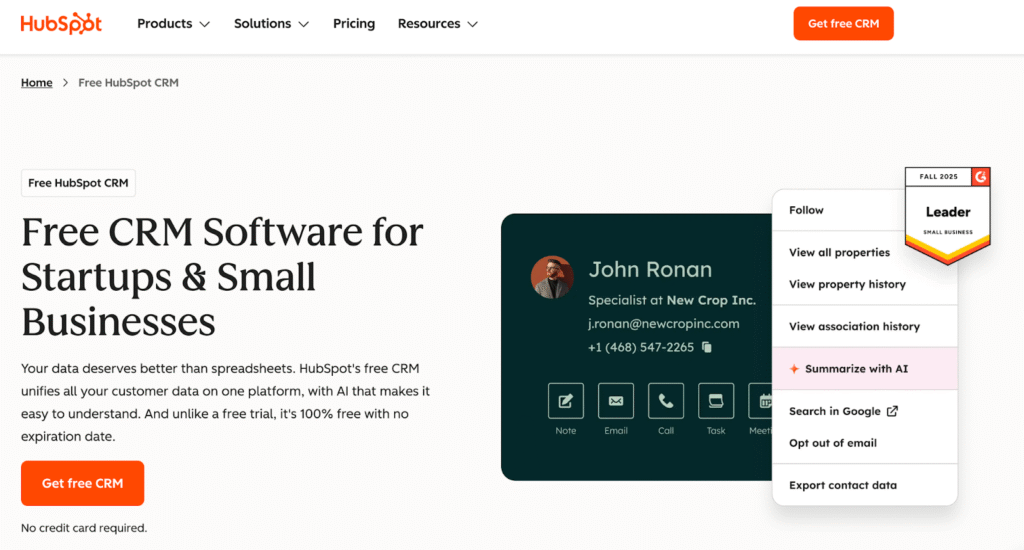
For brands where social touches marketing, sales, and customer success, HubSpot provides a unified framework that keeps all three aligned.
Key Features
HubSpot combines CRM, marketing automation, email tracking, pipeline management, and social monitoring in one system. Its social tools let you publish, schedule, and track social activity directly against contact records. This means teams can see how prospects interact with content, which posts drive interest, and when to follow up, all within the CRM.
Pros
Users love how seamlessly HubSpot connects social engagement with lead nurturing and sales workflows. The unified contact timeline, behavior tracking, and automation features give teams a complete view of every touchpoint. For sales-driven organizations, this alignment makes it easier to act on high-intent leads and personalize outreach.
Cons
HubSpot’s social capabilities are solid but not as deep as specialized social media tools. It lacks advanced social listening and omnichannel engagement, so it’s best suited for teams that prioritize CRM insights over full-scale CX management.
Pricing
HubSpot offers a wide range of plans across its CRM, Marketing, and Sales Hubs. Pricing scales with automation needs, contact volumes, and advanced features, making it flexible but potentially higher for teams needing enterprise-level capabilities.
Reviews
On Gartner and Capterra, HubSpot consistently scores high for usability, integrations, and CRM strength. Reviewers highlight how its social tools help unify marketing and sales workflows, making it one of the most efficient platforms for teams looking to connect content, engagement, and conversion.
7. Talkwalker
Talkwalker is a strong choice for brands that prioritize deep social listening, trend detection, and real-time brand monitoring. It shines in situations where teams need to track conversations at scale, not just on social platforms, but across news sites, blogs, forums, and even image-based media. For PR teams, research analysts, and brands operating in fast-moving industries, Talkwalker often becomes the go-to source for understanding the broader digital landscape.
Key Features
Talkwalker’s biggest strength is its listening engine. It analyzes conversations across millions of sources, detects sentiment shifts, identifies emerging trends, and even recognizes logos or objects in images shared online. The platform’s AI also highlights potential crises early, helping communication teams stay ahead of issues before they escalate. Its dashboards and data visualizations make it easy to explore large datasets and uncover actionable insights.
Pros
Teams love Talkwalker for the sheer depth of insights it provides. Whether it’s identifying trending topics, monitoring campaign impact across digital channels, or staying ahead of emerging crises, Talkwalker gives teams the intelligence they need. Its image and video recognition features are especially useful for brands with strong visual identities.
Cons
Talkwalker is built primarily for listening and analytics, so it doesn’t include robust publishing, engagement, or customer care tools. It’s not designed to manage omnichannel workflows or CX operations, which means teams often need an additional platform for day-to-day engagement.
Pricing
Talkwalker offers custom enterprise pricing based on listening depth, data coverage, and feature requirements. It’s best suited for mid-sized and enterprise teams with dedicated research, PR, or brand analysis functions.
Reviews
On Gartner and Capterra, Talkwalker is consistently praised for its powerful listening engine, accuracy of sentiment analysis, and ability to detect trends early. Reviewers often mention that Talkwalker helps them spot crises before they become visible on mainstream channels, a key advantage for PR-driven teams.
8. Meltwater
Meltwater is a long-established leader in media intelligence and monitoring, making it one of the best choices for PR teams, communications departments, and brands that need a holistic view of how they’re being talked about across the digital ecosystem. Rather than focusing purely on social media, Meltwater blends social monitoring with news, blogs, broadcast, and editorial coverage, giving teams a wider lens on brand reputation.
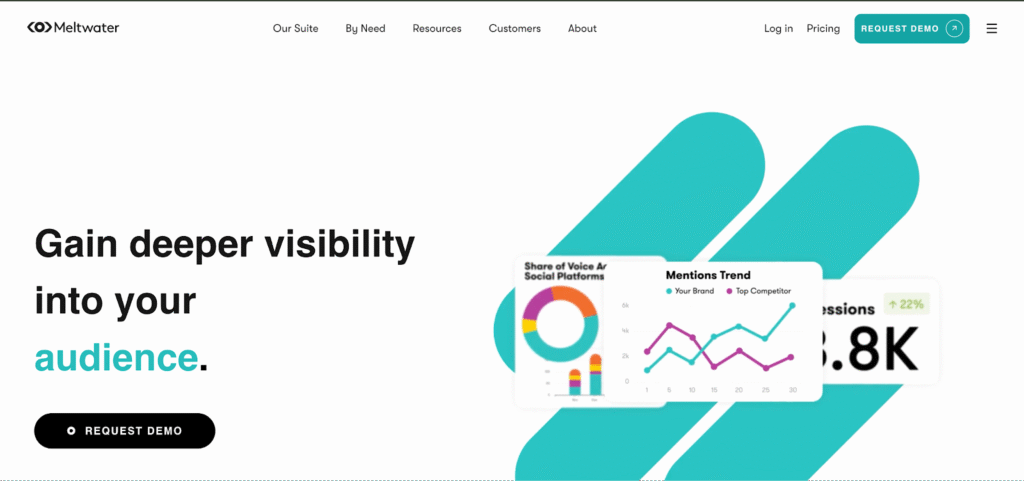
If your organization needs to stay on top of headlines, track industry conversations, or manage crisis communication across both traditional and digital channels, Meltwater provides the visibility to do it confidently.
Key Features
Meltwater’s standout strength is its combined news + social monitoring environment. Brands can track mentions across global news outlets, online publications, social media platforms, and broadcast sources. Its analytics tools help teams identify sentiment trends, measure coverage impact, and monitor how stories evolve. The platform also includes influencer identification, competitive benchmarking, and alerting tools, all aimed at helping PR teams react quickly and strategically.
Pros
Communications teams appreciate Meltwater for its expansive coverage and reliable alerts. It helps them catch news stories the moment they break, understand how conversations are spreading, and prepare more informed responses. For global brands and agencies, Meltwater’s breadth of data is a major advantage.
Cons
Meltwater is designed primarily for media monitoring rather than customer engagement. It doesn’t offer unified CX capabilities, omnichannel response tools, or publishing workflows, making it better suited for PR and brand reputation use cases rather than end-to-end customer experience management.
Pricing
Meltwater operates on custom pricing based on data volume, regions monitored, and feature requirements. It’s typically geared toward mid-sized and enterprise organizations with dedicated PR or comms teams.
Reviews
On Gartner and Capterra, Meltwater receives consistently strong reviews for its media monitoring accuracy, breadth of coverage, and quick alerts. Users highlight its ability to centralize news and social data in one view, making it a dependable tool for protecting and managing brand reputation.
9. Brandwatch
Brandwatch is one of the most powerful analytics platforms on the market, known for its ability to process massive volumes of social and web data and turn them into clear, strategic insights. It’s a favorite among large enterprises, research teams, and analysts who need deep segmentation, trend mapping, and data visualization, not just day-to-day social publishing.
If your team prioritizes understanding audience behavior, tracking sentiment shifts, and measuring campaign effects at scale, Brandwatch offers the kind of analytical depth few platforms can match.
Key Features
Brandwatch excels in advanced data processing. It gathers conversations from millions of online sources, social networks, blogs, forums, news sites, and organizes them into rich visual dashboards. Teams can segment audiences, compare trends over time, and dive into dataset patterns that inform long-term strategy. Its AI capabilities also help identify emerging themes, track competitor movements, and detect anomalies early.
Pros
Marketing and insights teams value Brandwatch for its depth and precision. The platform helps them uncover audience motivations, evaluate campaign impact, and analyze large datasets that would be impossible to parse manually. For enterprises with dedicated research or analytics functions, it’s a powerful engine for strategic decision-making.
Cons
Brandwatch is analytics-first. It doesn’t offer robust publishing tools or omnichannel customer engagement, which means teams often pair it with other platforms for execution and customer care. It’s best suited for organizations that need deep insights rather than full CX operations.
Pricing
Brandwatch uses enterprise-level pricing based on data access, modules, and analysis needs. It is typically geared toward mid-sized and large brands with mature analytics requirements.
Reviews
Across Gartner, G2, and Capterra, Brandwatch receives high marks for data accuracy, visualization capabilities, and analytical strength. Users often note how much easier it becomes to understand customer sentiment, track market shifts, and prepare stakeholder-ready insights, especially for global campaigns and research-heavy teams.
10. Khoros
Khoros is built for enterprises that manage high volumes of customer interactions across digital channels. It brings together social media management, digital care, and community forums into one ecosystem, making it particularly strong for large support teams who need advanced moderation, escalations, and customer service workflows. If your brand handles thousands of customer queries a day and requires structured processes across multiple teams, Khoros offers the operational depth to support that scale.
Key Features
Khoros combines social publishing, customer care, and community engagement into a unified platform. Its digital care suite allows agents to manage conversations across social media, messaging apps, and branded communities with clear routing and escalation paths. The platform also includes robust moderation tools, knowledge base integrations, and AI-assisted workflows that help teams triage large volumes quickly and accurately. For brands building self-serve communities, Khoros’ forum tools are a standout feature.
Pros
Enterprise support teams appreciate Khoros for its structure and control. Its moderation and escalation workflows ensure customer issues reach the right teams quickly. The community forums provide a unique way to drive self-service and peer-to-peer support. For brands prioritizing customer service at scale, Khoros delivers reliability and organization.
Cons
Khoros is designed for large, complex teams, which means it comes with a steeper learning curve. It’s not the simplest platform to implement, and it lacks the unified analytics and ease-of-use that CX-focused platforms prioritize. It can be more than what SMB or mid-sized teams typically need.
Pricing
Khoros offers enterprise-level pricing tailored to digital care volume, feature requirements, and the number of teams using the platform. It’s positioned at the higher end of the market and best suited for large organizations.
Reviews
On Gartner and Capterra, Khoros receives strong ratings for its digital care workflows, scalability, and reliability under high volume. Users frequently highlight its structured moderation tools and community features, though they also note the learning curve and implementation time.
Quick Comparison
Konnect Insights stands out as one of the most preferred Sprout Social alternatives. Here is a quick comparison table to help you gauge the tools side by side.
| Feature | Konnect Insights | Others |
| AI Insights | ✅ Built-in AI (sentiment, emotion, anomaly alerts, smart tagging, predictive insights) | ⚠️ Limited / add-on dependent |
| Omnichannel Engagement | ✅ Social, email, chat, WhatsApp, reviews, web, calls | ❌ Primarily social only |
| Unified Customer View | ✅ 360° profiles across all channels | ❌ Channel-specific only |
| BI Dashboards | ✅ Fully customizable dashboards & enterprise reporting | ⚠️ Standard social dashboards |
| Automation & SLA Tracking | ✅ Smart workflows, routing, auto-tagging, SLA management | ⚠️ Basic automation |
| Social Publishing & Calendar | ✅ Multi-user workflows, approvals, calendar | ✅ Strong publishing tools |
| Scalability | ✅ Enterprise-ready with flexible modules | ⚠️ More limited pricing & scalability options |
| Integrations | ✅ 1000+ tools (Salesforce, HubSpot, Genesys, AppFoundry, etc.) | ⚠️ More limited ecosystem |
| Support & Onboarding | ✅ Dedicated onboarding + success team | ❌ Ticket-based support |
For a detailed head-to-head Sprout Social vs Konnect insights comparison, check out the page.
How to Choose the Right Platform for Your Team
Step 1: Define Your Primary Goal
Decide whether your focus is marketing, full customer experience, or brand reputation. Your core objective will determine whether you need simple social scheduling or a unified CX platform.
Step 2: Check Integrations & Scalability
Make sure the tool fits into your existing CRM, helpdesk, and BI stack, and can grow with you as your team, channels, and workflows expand.
Step 3: Prioritize AI, Automation & Customer Visibility
Look for built-in intelligence like sentiment analysis, smart routing, SLA tracking, and unified customer profiles. These are the features that truly elevate your team’s speed and quality of service.
Final Thoughts: The Future of Social Media Management Is Unified CXM
Social media management is no longer a standalone function. As customer expectations rise, the industry is shifting toward platforms that bring social, CX, analytics, and automation together in one place. The next wave of growth will come from tools that can listen everywhere, respond intelligently, uncover trends early, and empower teams with a complete view of the customer journey, not just social engagement.
Sprout Social continues to be a strong option for brands focused primarily on content and social workflows. But teams that need deeper insights, omnichannel visibility, automation, and operational control are increasingly turning toward unified CXM platforms.
Konnect Insights is leading this shift for 2026. With AI at the core, omnichannel engagement, unified customer profiles, customizable BI dashboards, and automation built into every stage of the workflow, it gives teams the intelligence and scale they need to manage modern customer experiences.
If your brand is ready to move beyond scheduling and step into connected, insight-driven CX, Konnect Insights offers the foundation to get there, and grow with you.Book a Free Konnect Insights Demo to learn more about truly unified CX management