 Skip to content
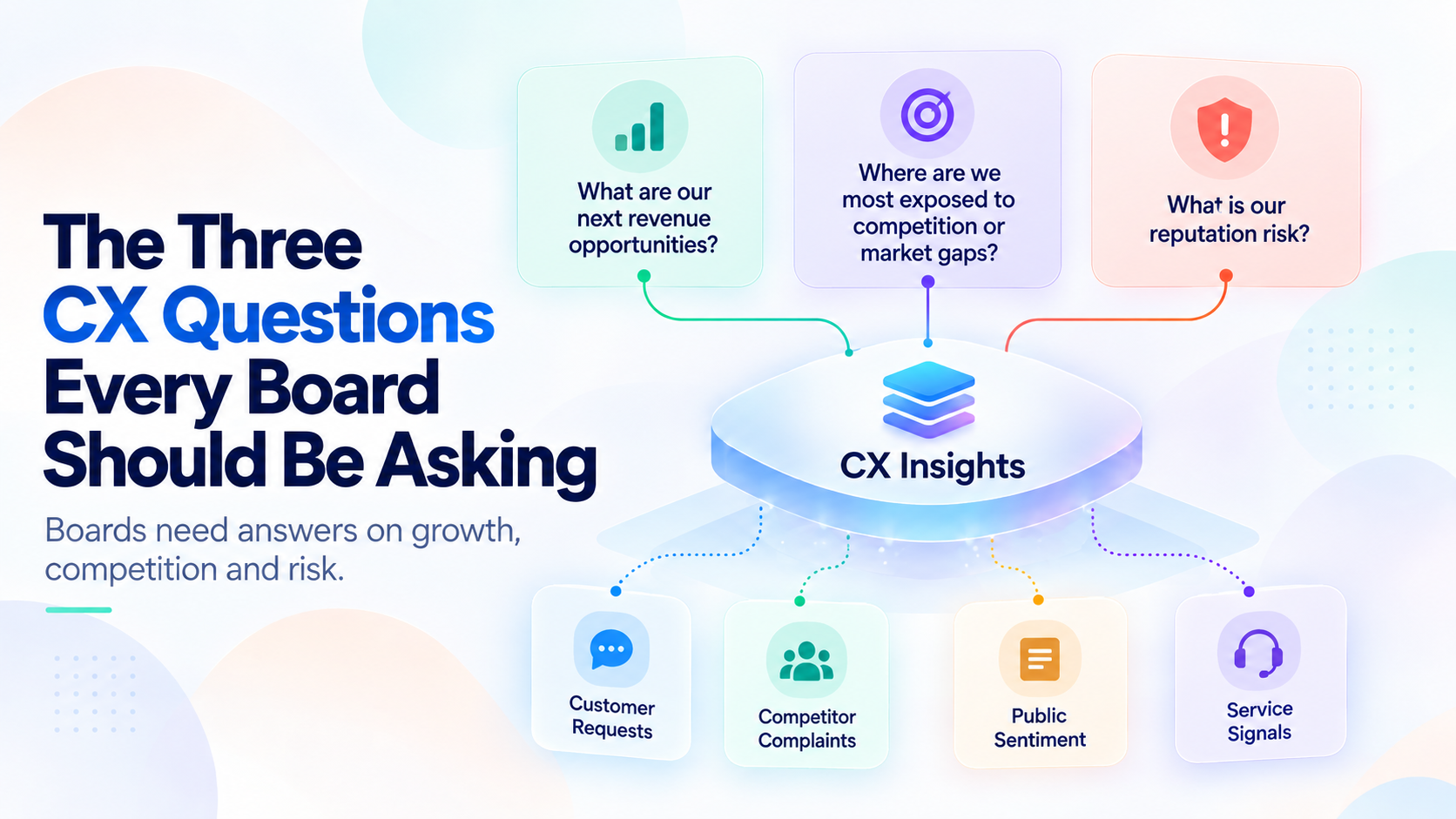


The Three CX Questions Every Board Should Be Asking
Boards ask CX teams for scores: CSAT, NPS, SLA. Those confirm whether the service operation is healthy. They say nothing about where growth is coming from, which competitive gap is open, or what reputational risk is forming. Three better questions exist, they are answerable from data the company already owns, and they move CX from the back of the board pack to the front.
- A score tells a board the queue is healthy. It does not tell them the business is.
- The three questions below are about growth, competition and risk, which is what boards govern.
- All three are answerable from existing customer conversation data. None requires new collection.
- Asking the same three every quarter is what makes trends visible and answers compound.
- If CX cannot answer them, that is itself the finding, and it has a cost.
Why the Current Questions Fall Short
There is nothing wrong with CSAT, NPS and SLA. They are control instruments for a service operation and they should continue to be reported.
The problem is what they crowd out. A board has limited attention per function. Spend it on three operational metrics and the function gets governed as an operation. Nobody asks what else the data could answer, because the format of the conversation has already decided what CX is for.
“CX was operations. That era is ending.”
Meanwhile the company holds, inside that same function, the largest body of unprompted customer evidence it owns. Millions of conversations containing what customers want, what they think of competitors, and what is about to go wrong. A board reviewing CSAT is standing on top of that and asking about the queue.
The three questions below are not harder to answer. They are simply never asked.
Question One: Where Is Our Next Revenue Coming From, Based on What Customers Are Actually Telling Us?
Not forecast. Not pipeline. Demand evidence from customers who already deal with you.
Three things make this answerable. Requests your customers make that you cannot fulfil, aggregated and weighted by the value of who asked. Capabilities customers describe building workarounds for, which is demonstrated need rather than stated want. And complaints from your competitors’ customers, which describe a market gap somebody is already failing to serve.
What a good answer contains. Three to five demand themes, ranked by revenue exposure rather than volume, with the customer segment each concentrates in and the actual conversations attached.
Why it belongs at board level. It is the cheapest growth input the company has access to, it is continuously refreshed, and no competitor can buy the same view of your customers.
Question Two: Which Competitor Gap Is Open Right Now, and How Long Will It Stay Open?
Competitive intelligence at most boards means pricing, feature comparison and whatever the sales team heard in a deal. All of it is lagging, filtered and collected during competition rather than before it.
Your competitors’ customers complain publicly every day. That is unfiltered product and positioning research on exactly the people you want to win, available continuously, and it comes with a timestamp so you can see whether a gap is widening or being closed.
What a good answer contains. Two or three specific capability or experience gaps where a competitor’s customers are visibly unhappy, with volume, trend direction, and an assessment of whether it is being addressed.
Why it belongs at board level. Gaps have a shelf life. One identified six months late is one somebody else filled. This is the question with the shortest window between knowing and acting.
Question Three: What Reputation Risk Is Forming That We Have Not Seen Yet?
Not what happened. What is forming.
Most customer-driven reputation events have a shape before they have a name: a theme accelerating within a defined audience, language sharpening, accounts with reach beginning to amplify. That formation period is usually hours to days, and during it the event is both visible and cheap to address.
The highest-value version of this question looks upstream at your own actions. Campaigns sent, policies changed, releases shipped, bot failures accumulating. The causes you control are the ones you can act on before any customer is affected.
What a good answer contains. Any themes currently accelerating, the audience each concentrates in, upstream causes correlated to them, and who is accountable for acting at what threshold.
Why it belongs at board level. Reputation sits squarely in a board’s risk remit, and this is the only version of it that arrives early enough to change the outcome.
Making the Answers Compound
Three practical conditions separate a one-off exercise from an intelligence capability.
Ask the same three every quarter. Constant questions make movement visible. Rotating questions produce disconnected snapshots.
Give each a named executive owner. Growth questions usually sit with the CEO or CPO, competitive with the CMO, risk with the CCO or CX Head. Unowned questions get answered once and filed.
Require evidence, not assertion. Every claim should link back to the conversations behind it. A board that can read the customer sentences underneath a finding governs differently from one reading a summary.
One note worth making plainly. If your CX function cannot answer these today, that is not a failure of the team. It is a consequence of how the function was scoped. But it is a finding, and it has a cost.
How Konnect Insights Approaches It
These three questions are the reason KRC exists in the form it does.
Beneath it sits the omni-channel platform: 30+ listening channels alongside omnichannel ticketing, social CRM and quality assessment, on one customer record, across 500+ enterprise brands in 35+ countries. That covers what customers say to you and what they say about you where you are not present, which is the half most internal systems never see. Cross-brand benchmarking supplies the competitor view that question two depends on, and contractual X data access matters for the risk question specifically.
Through MCP, KRC reads outward across CRM, marketing automation and contact centre systems, so demand themes carry commercial weight and reputation signals carry their upstream causes.
The output is built for the room it is going into: a short brief with findings ranked by exposure and the underlying conversations one click away, prepared ahead of the meeting rather than requested during it.
Frequently Asked Questions
Author


