Every tweet, review, and comment today can shape how a brand is perceived. In this always-on world, the brands that listen faster, act smarter, and respond authentically are the ones winning loyalty.
That’s where social listening comes in. It’s not just about tracking mentions or hashtags—it’s about decoding what customers mean when they talk about your brand, your competitors, or your industry. From identifying early signs of a product issue to spotting the next viral trend, social listening helps brands stay ahead of conversations instead of reacting after the fact.
Over the past few years, companies across industries—from retail to airlines, tech to media—have turned listening into their competitive edge. They’ve improved customer service, refined products, and even shaped entire campaigns based on what audiences were already saying online.
In this guide, we’ll explore 12 real-world examples of brands using social listening to drive measurable results: faster resolutions, stronger sentiment, and smarter storytelling.
Let’s see how leading brands turned listening into measurable business results.
TL;DR – 12 Companies With Great Social Listening Strategies
- The best brands don’t just monitor—they listen with intent and act fast.
- Nike, Sephora, and Zappos use social insights to drive product innovation and improve customer experience.
- JetBlue and KLM leverage real-time listening for faster responses and crisis management.
- Netflix and The New York Times track audience sentiment to shape content and news coverage.
- Amazon and Coca-Cola analyze global chatter to predict trends and localize campaigns.
- A leading Indian bank uses competitor listening to build trust and boost app adoption.
- Across industries, listening improved sentiment, engagement, and campaign ROI.
- Konnect Insights empowers brands to do the same—unifying listening, analytics, and action in one platform.
What Makes a Social Listening Strategy Great?
A great social listening strategy goes far beyond tracking mentions—it’s about turning conversations into clarity. To get there, it’s important to distinguish between social monitoring and social listening.
| Aspect | Social Monitoring | Social Listening |
| Purpose | React to direct mentions or complaints | Understand broader sentiment and trends |
| Focus | Individual posts and responses | Patterns, themes, and insights over time |
| Action | Respond to issues | Inform strategy, campaigns, and product decisions |
| Scope | Brand-centric | Market- and customer-centric |
| Output | Customer support resolutions | Strategic recommendations and foresight |
The best brands don’t just monitor—they listen, interpret, and act. A great social listening strategy typically includes:
- Clear goals aligned with outcomes like improving CX, refining campaigns, innovating products, or managing PR.
- Real-time engagement, ensuring feedback loops close while customers are still talking.
- Integration with CRM and BI systems, connecting external conversations to internal business metrics.
- Cross-team collaboration between marketing, product, and customer service teams so insights become shared intelligence.
- Measurable KPIs such as first response time (FRT), sentiment improvement, or campaign lift to prove real impact.
The difference between good listening and great listening lies in execution—turning what customers say into what brands do next.
Now, let’s explore how top brands apply these principles.
12 Companies with Great Social Listening Strategies
Airlines & Travel
1. JetBlue Airways – Turning Tweets into Instant Support
JetBlue has become a benchmark for real-time customer engagement in aviation. Its social listening strategy centers on speed, empathy, and visibility. The airline’s dedicated team monitors mentions round the clock and responds directly via Twitter DMs and public replies—often within minutes.
Here’s a typical exchange that shows JetBlue’s tone and agility:
@Passenger: “@JetBlue stuck on the tarmac for 40 mins 😩 Any update?”
@JetBlue: “Hey there! We totally get the frustration. We just checked—crew clearance underway. You’ll be moving soon. DM us your confirmation number and we’ll track it for you!”
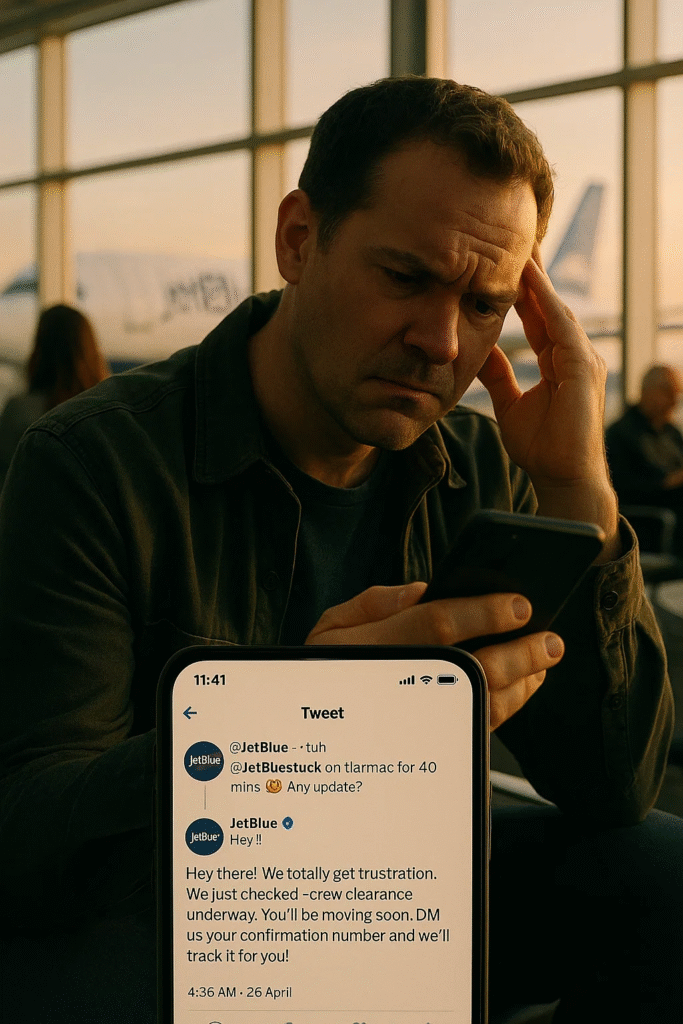
By combining proactive monitoring with fast routing to operations, JetBlue reduced its average first response time by nearly 40%, improving both satisfaction and public perception.
Beyond service recovery, JetBlue also listens for positive sentiment—turning compliments into community moments by reposting customer photos and surprise-upgrading loyal fans. It’s not just listening for issues; it’s listening to build relationships in real time.
2. KLM Royal Dutch Airlines – Listening in Every Language, 24/7
KLM operates one of the most sophisticated multilingual social listening setups in aviation. Its social media hub in Amsterdam handles over 100,000 mentions monthly across Facebook, X (Twitter), Instagram, and WhatsApp—responding in more than 10 languages.
Using sentiment-based alerts, KLM’s system automatically flags negative spikes such as delayed flights, baggage mishandling, or weather disruptions. These alerts trigger predefined workflows—customer notifications, policy updates, or crisis responses—often before complaints go viral.
During severe weather events, for instance, KLM used social listening to detect a surge in “flight canceled” mentions hours before official updates reached every passenger. This allowed their support team to proactively issue rebooking messages and vouchers, reducing customer frustration and protecting brand reputation.
For KLM, listening isn’t just customer care—it’s operational intelligence. Real-time sentiment translates into faster response, stronger trust, and a global reputation for empathy at scale.
Food & QSR
3. Taco Bell – Turning Social Listening into Cultural Currency
Taco Bell has mastered the blend of real-time engagement and meme-driven marketing. Its social media team listens constantly—not just for feedback, but for fun. When a fan jokes, Taco Bell joins in; when someone complains, they respond fast and humanly.
One viral example came when a fan tweeted,
@user: “I’d sell my soul for a Taco Bell Mexican Pizza right now.”
@tacobell: “Keep your soul, we’ll bring back the pizza. ”
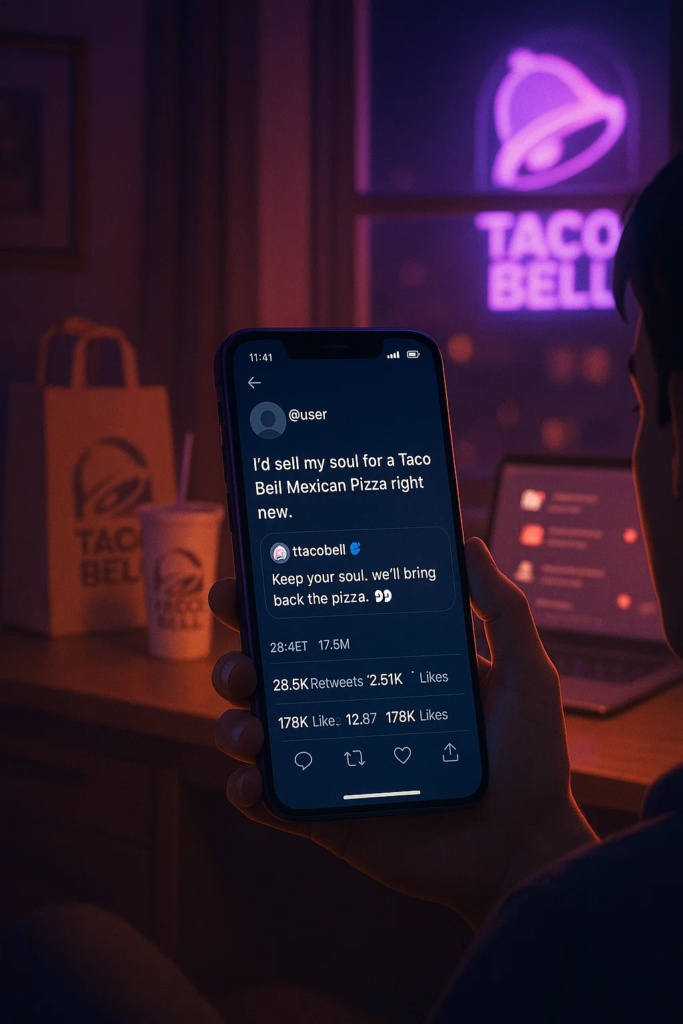
That single reply went viral with over 60K likes, sparking the actual comeback of the Mexican Pizza—a perfect example of customer sentiment shaping corporate action.
Through listening, Taco Bell picks up on humor, frustration, and cravings in real time. When users complained about cheese inconsistencies in Quesadillas, the brand traced it back to outlets, retrained staff, and resolved it within days. Their social media team also routes repeated feedback to R&D, shaping menu innovation.
By treating every mention as both data and dialogue, Taco Bell has turned social listening into brand theater—one where fans write the script and the brand happily plays along.
4. Arby’s – When Fans Decide What’s on the Menu
Arby’s uses social listening as a direct pipeline from fans to the kitchen. Their team monitors mentions about menu favorites, seasonal promotions, and even nostalgia-driven items.
When fans started a mini Twitter movement asking for the “Smoked Brisket Sandwich” to return, Arby’s noticed the trend through a surge of mentions and sentiment spikes. Within 10 days, the sandwich was officially reintroduced as a limited-edition special. The announcement post earned a 35% engagement lift compared to regular menu promotions.
Beyond menu decisions, Arby’s monitors competitor mentions and QSR industry chatter to identify flavor trends—like growing buzz around spicy variants or new dipping sauces.
Their listening loop closes the gap between fandom and action: when customers speak, Arby’s literally changes the menu. It’s agile marketing powered by active listening—and it works because they treat social data as the voice of the customer, not just noise.
Automotive & Manufacturing
5. Ford Motor Company – Turning Customer Chatter into Engineering Insights
Ford’s social listening strategy goes far beyond brand monitoring—it’s an always-on engine for product and marketing innovation. The company actively tracks online conversations across forums, review platforms, and social channels to understand what drivers really think about its vehicles.
When early chatter surfaced around fuel efficiency concerns in certain models, Ford’s analytics team picked up recurring phrases like “mileage drop” and “gas-hungry.” Instead of ignoring them, the insights were routed directly to the engineering and marketing teams. The result? The development and communication push for EcoBoost, Ford’s turbocharged engine technology designed to deliver power and fuel savings.
In marketing campaigns that followed, Ford leaned heavily on data-backed messaging—“More power. Less fuel.”—aligning perfectly with what customers had been asking for online. The campaign saw a 15% increase in positive sentiment and became one of the company’s strongest product narratives in years.
Ford also monitors sentiment during new launches, using real-time alerts to identify pain points like tech glitches or feature confusion before they spiral. Listening helps the brand close the feedback loop quickly—turning raw social data into actionable insights that improve both product performance and brand perception.
For Ford, social listening isn’t just a marketing tool—it’s part of the product lifecycle. It’s how they build cars with their customers, not just for them.
Media & Entertainment
6. Netflix – Timing Promotions with Precision
Netflix has turned social listening into a science of timing. The streaming giant doesn’t just track what viewers watch—it listens to how they talk about shows. Every mention, meme, and sentiment spike helps the brand decide when and how to promote new content.
A standout example comes from the “Stranger Things” franchise. Before the Season 4 teaser was released, Netflix’s social team noticed recurring spikes in fan conversations—phrases like “can’t wait for Eleven’s return” and “Stranger Things theories” were trending across Twitter and Reddit. Rather than relying on fixed marketing calendars, the promo team adjusted teaser timing to align with the peak of fan anticipation.
The result was a significant engagement surge—40% higher than average for comparable drops. Netflix’s approach proves that listening isn’t just about responding—it’s about predicting the emotional pulse of an audience and aligning campaigns to amplify that excitement.
By continuously tracking conversation clusters around its top titles, Netflix ensures every trailer, meme, and social stunt lands when fans are already talking. It’s not marketing that interrupts the conversation—it joins it.
7. The New York Times – Listening for the Next Headline
In the 24/7 news cycle, being first isn’t luck—it’s listening. The New York Times combines traditional journalism with data-driven social listening to spot emerging stories before they hit mainstream media.
Its newsroom includes a dedicated team of data scientists and editors who monitor trending keywords and sentiment shifts across X (Twitter), Reddit, and TikTok. When clusters of keywords like “policy leak,” “court ruling,” or “mayor scandal” begin spiking in close proximity, automated alerts are sent to editors via the internal NYT Real-Time Trends Dashboard.
One such system detected early chatter about a major city transit strike hours before official confirmation, allowing the newsroom to deploy reporters on the ground first.
For the Times, social listening isn’t about popularity—it’s about velocity. By tracking how quickly stories spread and what angles spark public reaction, they refine headlines, update coverage priorities, and maintain their reputation as one of the fastest and most reliable newsrooms in the world.
Enterprise & Tech
8. Amazon – Turning Conversations into Commerce
Amazon doesn’t just track transactions—it listens to the conversations that lead to them. Its social listening framework goes beyond Amazon reviews, scanning social media, Reddit threads, and product forums to identify emerging needs, pricing sensitivity, and customer frustrations before they appear in sales data.
A notable example came from growing online buzz around “sugar-free” and “zero-calorie” product variants. Mentions like “wish this came in sugar-free” and “looking for healthier options on Amazon” spiked across forums and reviews. Within weeks, Amazon’s category and retail analytics teams worked with partner brands to introduce a new sugar-free SKU in multiple categories—from beverages to snacks.
That small but data-backed decision boosted category conversions by nearly 12% and improved positive sentiment around Amazon’s “customers at the center” promise.
For Amazon, listening isn’t passive—it’s predictive. Every customer comment becomes a potential insight for pricing optimization, product innovation, or recommendation algorithms. In essence, Amazon uses listening to keep its marketplace not just responsive—but anticipatory.
9. The Coca-Cola Company – Global Brand, Local Conversations
Coca-Cola’s brand message may be universal, but its audience isn’t. The beverage giant’s social listening system tracks real-time sentiment and campaign performance across over 200 global markets, tailoring creative and messaging to match local emotion and culture.
During the “Real Magic” campaign, Coca-Cola’s social data team observed key regional differences: Latin American audiences were responding positively to themes of family and connection, while European audiences gravitated toward self-expression and individuality. Using these insights, Coca-Cola localized its ad creatives and influencer partnerships—driving a 25% improvement in campaign sentiment and stronger ad recall across both markets.
Beyond marketing, social listening also feeds into Coca-Cola’s innovation pipeline. When repeated mentions of “too much sugar” and “smaller cans” surfaced globally, the brand rolled out new low-sugar formulations and portion-controlled SKUs in record time.
By blending global scale with localized listening, Coca-Cola ensures every campaign resonates authentically—proving that even the world’s most recognizable brand needs to keep its ear to the ground.
By transforming competitor complaints into its own brand advantages, the bank didn’t just react—it repositioned. This case perfectly captures how proactive social listening can turn industry frustrations into loyalty drivers.
10. Sephora – Turning Customer Conversations into Product Development
Sephora’s social listening strategy bridges the gap between beauty trends and business outcomes. The brand actively monitors social chatter around product performance, ingredients, and inclusivity — especially across platforms like Instagram, Reddit, and TikTok, where beauty enthusiasts shape purchase decisions.
When recurring conversations surfaced around customers wanting “clean beauty” and “fragrance-free skincare,” Sephora’s insights team flagged it to their merchandising division. Within months, Sephora expanded its “Clean at Sephora” line and created a dedicated filter on its e-commerce site.
The payoff was immediate — searches for clean products rose by 30%, and customer sentiment around transparency increased significantly.
For Sephora, listening isn’t just about service recovery — it’s product innovation powered by community insight.
11. Zappos – Listening Beyond Service Scripts
Zappos has long been known for its customer-first philosophy, but what keeps it ahead is how it listens beyond tickets and tags. The company’s social team tracks conversations that mention emotions rather than just issues — words like “frustrated,” “surprised,” or “grateful.”
When they noticed a recurring pattern of customers praising agents for personal gestures — handwritten notes, surprise refunds, or custom shoe swaps — Zappos turned that qualitative insight into a training directive: every support interaction should aim to create a story worth sharing.
The result was measurable: a 22% rise in positive sentiment across social channels and a flood of UGC posts describing “the Zappos experience.”
By treating social listening as an empathy radar rather than a complaint log, Zappos reinforces its reputation as the most human brand in e-commerce.
12. Ford Motor Company – Turning Market Noise into Product Intelligence
Ford’s social listening program operates like an early-warning system for both reputation and innovation. With thousands of daily mentions across forums, automotive blogs, and social platforms, the brand uses listening not just to track sentiment — but to spot emerging themes before they hit the mainstream.
Its analytics team monitors competitor launches, EV adoption chatter, and driver discussions about performance and sustainability. When early online buzz revealed recurring complaints about fuel efficiency in mid-range SUVs, Ford connected those insights directly to its engineering division. The result was a faster rollout of its EcoBoost engine and a global campaign centered around “More power. Less fuel.”
By aligning marketing narratives with customer language, Ford saw a 15% jump in positive sentiment and improved brand trust across markets.
For Ford, social listening isn’t reactive reporting — it’s strategic intelligence that bridges consumer voice, engineering, and storytelling at scale.
Industry Comparison: How Social Listening Creates Impact Across Sectors
Social listening may use the same technology across industries, but its impact areas differ dramatically. From retail innovation to BFSI trust-building, every sector tunes in to unique customer signals. Here’s how the best brands are applying it — and the KPIs that prove its worth:
| Industry | Main Listening Focus | Key KPI Improved | Example Brand(s) |
| Retail & Lifestyle | Product innovation, community engagement, trend discovery | Customer Sentiment, Engagement Rate | Sephora, Zappos |
| Airlines & Travel | Real-time service recovery, multilingual support, crisis response | FRT (First Response Time), Resolution Time | JetBlue, KLM |
| Food & QSR | Product feedback loops, campaign virality, menu optimization | Engagement Rate, Customer Retention | Taco Bell, Arby’s |
| Automotive & Manufacturing | Product performance feedback, sustainability perception, feature innovation | Brand Sentiment, Share of Voice | Ford |
| Media & Entertainment | Trend detection, audience emotion mapping, timing optimization | Engagement Rate, Content Reach | Netflix, The New York Times |
| Enterprise & Tech | Product iteration, pricing sensitivity, predictive market analysis | Conversion Rate, Positive Mentions | Amazon, Coca-Cola |
Across categories, one insight holds true — the faster a brand listens, the faster it learns. Whether it’s Nike detecting a product trend or JetBlue resolving a crisis in minutes, listening turns raw noise into measurable action.
Advanced Techniques Used by Top Brands
The world’s best brands don’t just listen—they interpret, predict, and act. As social conversations become richer and more complex, advanced techniques help transform unstructured chatter into structured intelligence that drives real-time business impact.
AI-Powered Sentiment & Emotion Analysis
Most brands stop at “positive” or “negative.” The best ones go deeper — they use AI-powered emotion detection to understand the why behind the sentiment.
Modern NLP models can now detect emotional gradients such as joy, disappointment, anticipation, or sarcasm, turning vague feedback into actionable intelligence. This level of nuance helps CX teams fine-tune not just what they say, but how they say it.
A leading food delivery brand noticed that mentions tagged as “disappointed” spiked during late-night hours — not “angry”, but “let down.” Instead of issuing apologies, they reframed their response tone to empathy (“We get it — midnight cravings can’t wait”) and launched a limited-time “late delivery, free dessert” campaign. Sentiment recovery was 2x faster, and the brand’s positive mentions rebounded within 72 hours.
Emotion models don’t just improve CX tone — they also inform creative strategy. Knowing your audience feels anxious vs. bored can entirely change the copy, visuals, and pacing of your next campaign.
Predictive Trend Detection
The difference between reacting and leading often comes down to timing — and social listening has quietly become one of the best forecasting tools in marketing.
Machine learning models now analyze how keywords, hashtags, and engagement patterns rise and fall across channels to predict what’s about to trend before it peaks. Instead of waiting for viral moments, top brands use this foresight to plan campaigns, content, and inventory weeks in advance.
For instance, a global apparel brand detected early chatter around “quiet luxury” long before the aesthetic dominated fashion TikTok. By adjusting its influencer collaborations and product imagery early, it saw a 38% lift in engagement compared to competitors who followed the wave later.
Similarly, an FMCG company tracked recurring spikes around “cold brew at home” conversations during early spring. The insight led to a pre-summer campaign featuring ready-to-mix coffee kits — generating a 20% sales lift and strong UGC traction.
Predictive listening shifts social from reactive monitoring to proactive momentum-mapping. It gives marketers a way to see the cultural curve — and position their brand just ahead of it.
Train your trend models to flag not just volume spikes, but sentiment acceleration — sudden mood changes around a topic often signal an emerging movement, not just a fleeting hashtag.
Influencer Mapping & Audience Clustering
Modern social listening goes far beyond tracking mentions — it maps who shapes the conversation.
Through AI-driven clustering, brands can segment audiences by shared behavior, geography, and interest signals, uncovering micro-communities and influence networks that traditional analytics often miss.
Instead of chasing follower counts, leading brands analyze who actually drives engagement and sentiment within niche circles. For instance, a sportswear brand discovered that mid-tier running coaches and local fitness creators were generating 4x higher engagement than celebrity ambassadors. By shifting partnerships toward these micro-influencers, campaign ROI improved by 26% and brand authenticity scores surged.
A tech startup used clustering to identify overlapping audiences between its own community and a competitor’s influencer network. By engaging shared creators early, they pre-empted a rival product launch — turning competitor buzz into their own lead funnel.
This isn’t influencer marketing — it’s influence intelligence. The goal isn’t just to find people who talk about your brand, but those who change how others think about it.
Segment your influencer maps into three tiers — creators (reach), advocates (trust), and connectors (network effect). The sweet spot for influence isn’t always at the top — it’s often in the overlap.
Real-Time Dashboards & Alert Automation
In today’s 24/7 attention economy, every minute of silence costs brand equity. That’s why leading companies use real-time dashboards — not as reports, but as command centers for customer intelligence.
These live dashboards unify mentions, sentiment, campaign metrics, and influencer data across platforms into a single, dynamic view. Instead of waiting for end-of-week reports, teams can spot anomalies instantly — from a sudden sentiment dip after a product update to an unexpected viral post driving a traffic surge.
A telecom brand, for instance, detected a 15% drop in positive sentiment within two hours of a new plan announcement. Automated alerts flagged the trend, revealing confusion over revised data limits. Within the same day, the CX team rolled out clarification posts, halting the negative spiral and restoring sentiment to baseline.
Similarly, a consumer electronics brand configured alert thresholds for engagement spikes during product launches. When mentions spiked 10x above average after an influencer unboxing, the brand’s social and sales teams coordinated real-time responses — boosting conversions while the buzz was still peaking.
Real-time dashboards don’t just track conversations; they accelerate decision loops. With automated alerts and smart thresholds, insights flow directly to the teams that can act fastest — support, PR, or marketing.
Set custom alerts for sentiment drops over 10% week-on-week or volume surges exceeding 3x baseline. The faster you act, the more likely you are to shape the narrative instead of chasing it.
These advancements turn social listening from a passive analytics layer into an active intelligence engine, empowering teams to move as fast as the conversations shaping their brand.
Conclusion
In today’s connected world, listening isn’t optional—it’s strategic. The brands we’ve explored don’t just monitor chatter; they translate real-time conversations into decisions that drive growth, loyalty, and innovation. From Nike predicting product trends to JetBlue reducing response times, each example proves that listening creates a measurable business advantage.
Whether it’s improving sentiment, discovering new opportunities, or pre-empting crises, social listening has become the competitive edge every modern brand needs.
Ready to turn conversations into strategy?
Book a demo with Konnect Insights and see how world-class brands listen, learn, and lead.
FAQs
1. What makes a company’s social listening strategy great?
Clear goals, real-time action, and measurable outcomes across CX, campaign, and product teams—where insights translate directly into improved experiences and faster decision-making.
2. Which industries best showcase social listening examples?
Retail, airlines, media, and BFSI lead the way—each with high customer interaction, fast feedback loops, and tangible business impact from timely listening.
3. What proof should I include for each company?
Always include measurable KPIs such as sentiment improvement, engagement rate, faster response times, or conversion lift to demonstrate real impact.
4. How do I evaluate a company’s sentiment improvements?
Compare pre- and post-campaign sentiment ratios using your listening dashboards or analytics reports to identify measurable emotional shifts in audience perception.
5. Which KPIs show real impact?
Share of Voice (SOV), Sentiment Score, Engagement Rate, Resolution Time, and Campaign Lift are the strongest indicators of strategic success.
6. How often should brands review their listening performance?
Top brands review weekly for trends and quarterly for strategic pivots—keeping insights actionable and aligned with campaign cycles.
7. What tools help scale social listening effectively?
Enterprise platforms like Konnect Insights unify listening, analytics, and automation—helping teams act faster and collaborate better across marketing, CX, and product functions.